| ::: MAIN MENU ::: |
|---|
| ⚡ Submit Manuscript |
| Editorial Team |
| Reviewer |
| Focus and Scope |
| Editorial Process |
| Publication Ethics |
| Author Guidelines |
| Indexing |
| Fees |
| Copyright and License |
| Open Access Statement |
| MANUSCRIPT TEMPLATE |
|---|
| Download Template (.docx) |

Tekinfo Transactions on Software Engineering (InfoSE) follows a transparent, rigorous, and efficient editorial process designed to uphold the highest standards of scientific publication. Every submission is handled with impartiality and confidentiality. The process from initial submission to final publication decision typically takes between eight and twelve weeks, depending on the complexity of the manuscript and the availability of reviewers. The diagram below provides an overview of the complete editorial workflow, followed by a detailed description of each stage.
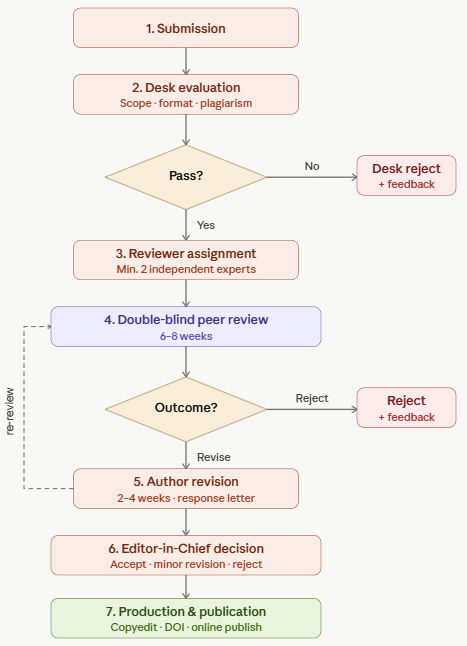
Authors submit their manuscripts exclusively through the InfoSE online submission portal powered by Open Journal Systems (OJS). Before submitting, authors are required to confirm that the manuscript is original, has not been published elsewhere, and is not currently under review at any other journal. The corresponding author must create or log into an OJS account, complete all required metadata fields — including a structured abstract, keywords, and author affiliations — and upload the manuscript file in accordance with the journal's Author Guidelines. Upon successful submission, an automated acknowledgement is sent to the corresponding author with a unique manuscript tracking number.
All submitted manuscripts are first evaluated by the Managing Editor and, if necessary, the Editor-in-Chief before being sent out for external peer review. The desk evaluation assesses whether the manuscript falls within the journal's focus and scope, whether it meets the minimum structural and formatting requirements set out in the Author Guidelines, whether the work demonstrates sufficient methodological rigour to warrant external review, and whether the originality check (conducted via plagiarism detection software) returns an acceptable similarity index. Manuscripts that fail the desk evaluation are returned to the authors within five to seven working days with a brief explanation of the reasons for the decision. Desk rejection does not preclude resubmission once the identified issues have been addressed.
Manuscripts that pass the desk evaluation are assigned to at least two independent expert reviewers with relevant subject knowledge. Reviewers are selected from the journal's reviewer panel or invited on an ad hoc basis from the wider academic community. The Managing Editor and Editor-in-Chief take care to avoid conflicts of interest by excluding reviewers who share an institutional affiliation with any of the authors, who have co-authored with any of the authors within the past five years, or who have declared a competing interest. Authors may suggest preferred reviewers and may also identify individuals they wish to be excluded, though the editorial team is not obligated to follow these requests.
InfoSE employs a double-blind peer review process in which the identities of both authors and reviewers remain concealed throughout the review. Authors must therefore ensure that their manuscripts do not contain any self-identifying information in the text, acknowledgements, or file metadata prior to submission. Each reviewer is invited to complete their evaluation within four weeks of assignment and is asked to assess the manuscript against four criteria: the significance and originality of the contribution, the soundness and reproducibility of the methodology, the clarity and organisation of the presentation, and the relevance of the work to the journal's scope. Reviewers submit a structured evaluation report and a recommendation: Accept, Minor Revision, Major Revision, or Reject. The complete review process, from reviewer assignment to receipt of all reports, targets a six-to-eight-week window.
If the editorial decision requires revision, the corresponding author is notified via OJS and provided with the consolidated reviewer reports. Authors are given two to four weeks to prepare and submit a revised manuscript accompanied by a detailed response-to-reviewers letter that addresses every point raised by each reviewer. The response letter must clearly indicate the location of each change in the revised manuscript, either by page and line number or by quoting the revised passage directly. Revised manuscripts are ordinarily returned to the original reviewers for re-evaluation, though the Editor-in-Chief may exercise editorial discretion and make a decision without further external review when the revisions are straightforward. Authors who are unable to meet the revision deadline should contact the editorial office before the deadline to request an extension.
The final editorial decision rests with the Editor-in-Chief, who considers the reviewer recommendations and reports, the adequacy of the authors' revisions, and the overall quality and fit of the manuscript with the journal's standards. The possible outcomes are: Accept as Submitted, Accept with Minor Revisions, Request for Major Revision, or Reject. All decisions are communicated to the corresponding author through the OJS platform with the relevant reviewer comments attached. The editorial decision is final; however, authors who believe a decision was made in error may submit a formal appeal in writing to the Editor-in-Chief, providing clear grounds for the appeal that go beyond a disagreement with the reviewers' assessment.
Accepted manuscripts are passed to the production team for copyediting, layout formatting, and proofreading. The manuscript is typeset according to the journal's house style, figures and tables are checked for resolution and consistency, and the reference list is verified for completeness and correct formatting in IEEE style. A formatted proof is sent to the corresponding author for final verification. Authors are asked to return the approved proof within 48 to 72 hours and should limit corrections at this stage to typesetting errors and factual inaccuracies; substantive changes to the content are not permitted. A Digital Object Identifier (DOI) is assigned to the accepted manuscript prior to publication.
Following approval of the final proof, the article is published online in the current issue of InfoSE. All articles are immediately and freely accessible under the Creative Commons Attribution Share Alike (CC BY-SA) in accordance with the journal's open-access policy. The article is indexed under the assigned DOI, and the corresponding author receives a final publication notification. Articles are allocated to a specific volume and issue number upon publication.